Showing posts with label kochgeschirr. Show all posts

Thursday, January 2, 2014

A Mess Tin Primer, Part II

Part II - Kochgeschirr-type Mess Tins

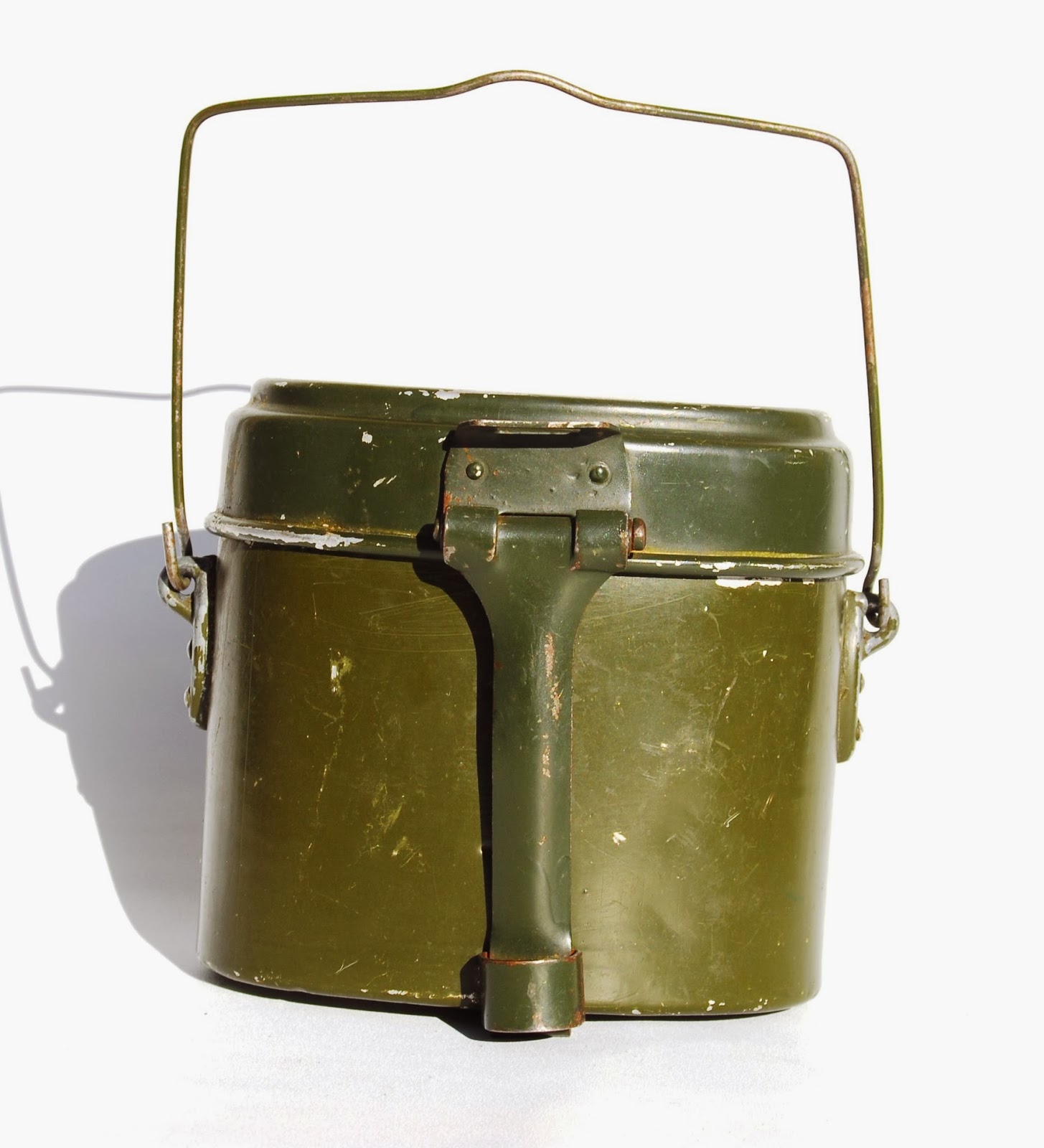
     It was seen in an earlier post that mess tin designs often developed along parallel tracks. However, one design that undoubtedly influenced many other 20th century mess tins was the German Kochgeschirr (lit.: cookware) Modell 31, commonly referred to as the Kochgeschirr 31 or M31. The Kochegeschirr 31 was shortened and improved derivative of the Kochgeschirr 27. The Kochgeschirr 27 which was an aluminum version of the tinned steel M1915/17, in turn derived from the M1910. The Kochgeschirr 27 was manufactured through 1940. The capacity of the two models were as follows:
                                 body (Unterteil           lid (Kochgeschirrdeckel)
Kochgeschirr 27        2.14 liters                      1.71 liters
Kochgeschirr 31        0.76 liter                        0.54 liter

Kochgeschirr M1910
http://gerhard03.blog61.fc2.com

Measuring marks in ½ liter increments were stamped into the body. Late-war versions of the M31 saw a change in the design of the handle lugs to ease manufacture and the elimination of the measuring marks on the body. Enameled steel staged a comeback in some M31s as aluminum was diverted to more critical areas of war production. Although originally produced without an insert, by 1945 some M31s were being produced with an insert, a somewhat unusual development in light of critical wartime shortages of metals.


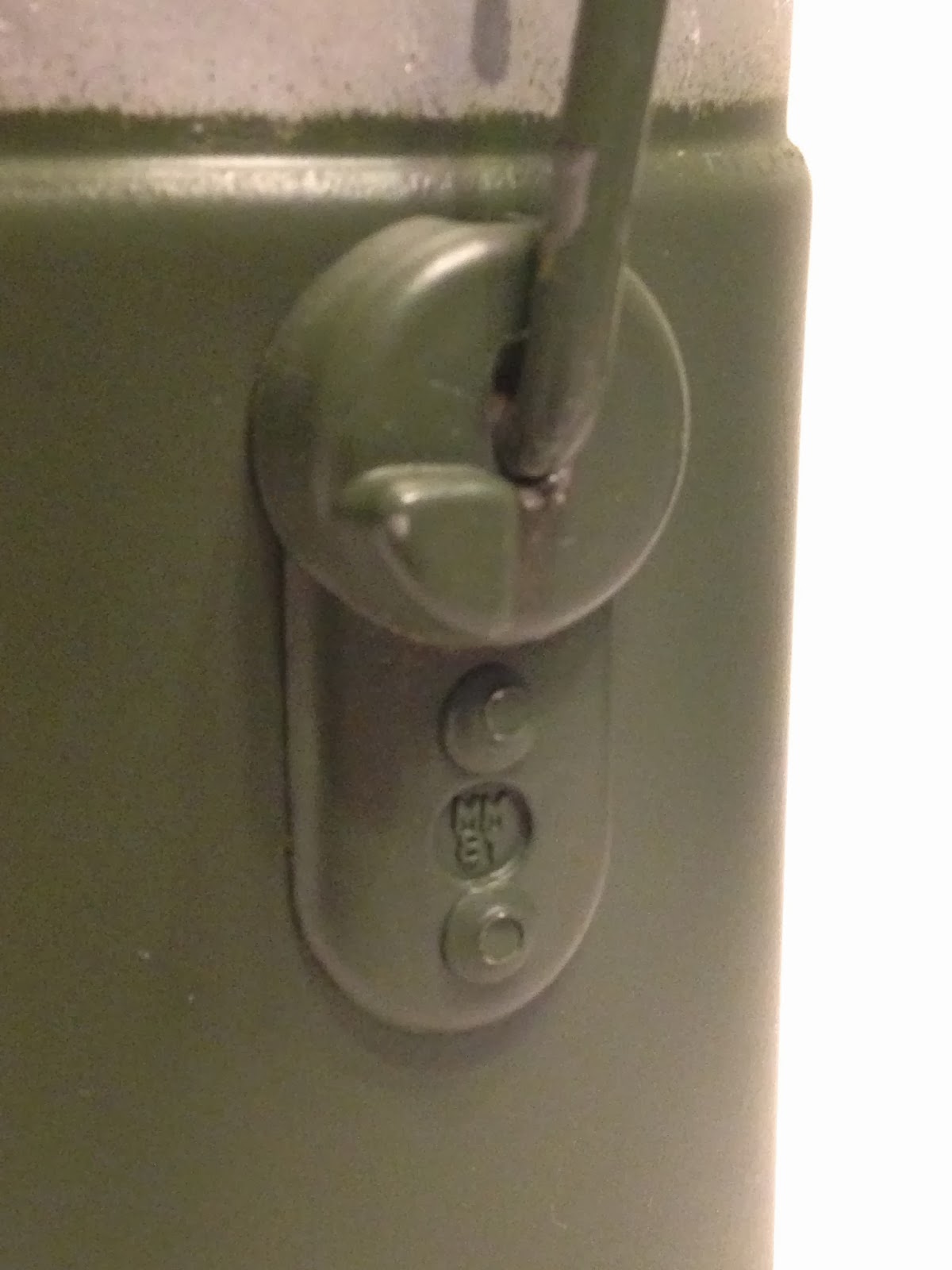
German M31 marked with L&SL40 stamped onto the lid and handle lugs. L&SL is the manufacturer's code, and 40 the year of manufacture.   
There are several features that are common to "Kochgeschirr-type" mess tins:
  • two-piece construction, consisting of a body and a lid which fits over the top portion of the body
  • A "kidney" shape when viewed from above; similar types may have an oval or "D" shape. 
  • wire bail attached to the lower section
  • hinged flat metal handle attached to the lid (an exception was the German M1887 Kochgeschirr's handle, which was separate)
For the purposes of this post I have provided an illustrated glossary of mess kit nomenclature. The nomenclature is not “official”, but intended only to clarify references to specific parts of the Kochgeschirr in this post. 


Kochgeschirr-type mess tin nomenclature
Body - the lower part of the mess tin.
Lid - the cover, which can be inverted and used as a frying pan.
Handle lug - a projection on the side of the mess tin body, used to hold the bail in place. Lugs may be in          the form of a loop or a stud.
Bail - a wire handle, attached to the sides of the mess tin, and used for carrying the mess tin or hanging           it over a cooking fire.
Strap loops - metal loops, attached to the body, lid or lid handle, through which straps (ususally made           of leather) are passed to secure the lid to the body and/or the mess tin to the soldier's field gear.

Some Kochgeschirr-type mess tins may be equipped with an insert, a shallow dish that fits inside of the body, and serves as an additional serving bowl.  

Kochgeschirr 31 Descendants
Prior to and during World War II, various nations copied the design of the Kochgeschirr. Several of these are illustrated below.

Soviet M36 mess tin, post-WWII manufacture. The Soviet M36 mess tin was copied from the German M31, with the only major modifications being the shape of the handle lugs and three rivets on the lid handle instead of two.


Finnish Mess Tin. 
WWII-era Finnish mess tins also claim parentage from the German M31. During WWII, Finnland also used German M31s, British mess tins supplied during the 1939-40 Winter War, and captured Soviet mess tins. Note the differences in the lid handle, especially the lack of an upper strap loop.
(www.varusteleka.com)
After WWII a number of nations manufactured copies of the M31. With the exception of the manufacturer’s marks, the Austrian and Romanian versions are virtually indistinguishable from the pre- and early-war M31. The Austrian, Polizei, Bundeswehr and DDR mess kits were issued with an insert.

Austrian post-WWII Kochgeschirr. It has few discernible differences from the wartime M31: there are no manufacturer's marks on the handle lugs, and different markings where the lid handle is attached to the lid. This example is marked with "HV 84" (Heeresverwaltung - Austrian Federal Army; 84 is the date of manufacture, 1984), underneath it "JGB", the manufacturer's abbreviation.
The Austrian Kochgeschirr with insert. The insert has 2 slots that allow the end of the lid handle to be inserted so that both the lid and insert can be carried in one hand.

This Romanian Post-WWII Mess Kit is nearly identical to the German M31, with the exception of smaller handle rivets and the complete absence of manufacturer's markings or stamps.

A variant produced for the West German Police was similar to the M31, except that the handle lugs were similar in shape to those of the Soviet M36.(http://www.varusteleka.com)

The West German Bundeswehr adopted a modified version of the M31 in the 1960s. It had a higher lid; note the approximate 8 mm space between the top of the upper strap loop and the ridge on the lid. The handle lugs were changed to a circular socket type.

Meanwhile, on the other side of the Iron Curtain the DDR (East Germany) produced a simplified descendant of the M31. The handle lugs were similar, but smaller, than those on the original M31. It also lacked the upper strap loop. The lower strap loop could be a full loop, or sometimes only a flange on either side of the handle. The handle was secured to the lid with 3 rivets.

Comparison of (left to right) East German, WWII M31, and West German Kochgeschirr. Again, color is not a reliable indicator, especially in the case of the East German Kochgeschirr. I have examples in varying shades of gray/green, and have seen some repainted to mimic WWII Kochgeschirr.
Some models were nearly exact copies of the M31, others were slightly modified, but many types follow the M31’s dimensions so closely that the lids and bodies are interchangeable. To illustrate the point, the photo above shows lids interchanged between a Soviet M36, East German and Austrian Kochgeschirr.
Kochgeschirr M31 Look-Alikes
Though not necessarily derived from the German WWI or WWII Kochgeschirr, numerous other mess kits are often incorrectly identified or misrepresented as such. The Wehrmacht's policy of utilizing captured equipment, including mess tins, further adds to the confusion. Some examples of captured mess tins were repainted before re-issue.

Post-WWII Polish Mess Kit M.23/31 (Menazka wz.23/31). The prewar Polish M.23/31 was constructed of tinned steel. Post-war versions had no manufacturers markings and were made of aluminum. Note the higher "shoulder" on the lid and the vertical strap loop on the lid handle.

Polish wz.70, replacement for the wz.23/31. The shorter body and high lid give it a squat appearance.
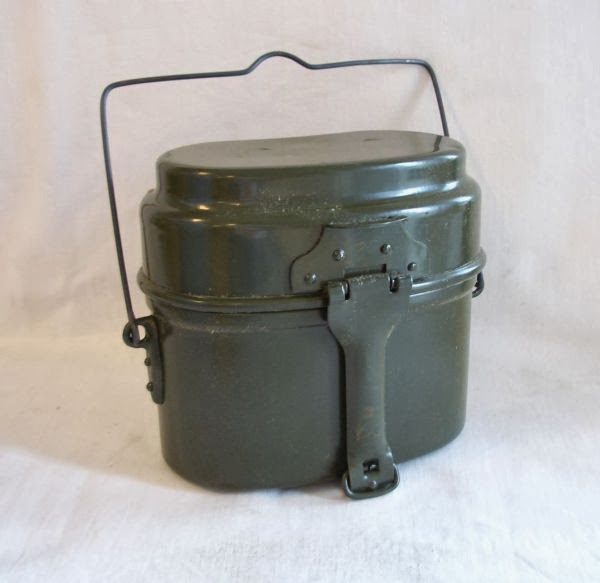
Hungarian 65M, another post-WWII variant.
Appearing at first glance to be an M1910 Kochgeschirr, it's big (2 liter capacity), impressive, and ....Swiss, not German. However, the "D-shape", stud-type handle lugs, lack of German-style strap loops, and the cutout in the handle are identifying features that distinguish it from the German M1910.

Basically a shortened version of the Swiss mess tin, this type of Norwegian mess tin was manufactured from 1960 through 1975. The Norwegian mess tin is often confused with the Swiss.

Comparison of Swiss (left) and Norwegian (right) mess tins.

German WWII M31s are much sought after by collectors and reenactors. Unfortunately there are vendors who, either through ignorance or willful intent, have listed many a post-WWII mess tin as a German WWII Kochgeschirr. There are a number of ways to determine whether that M31 you are eyeing is genuine or not:
  • The date and manufacturer’s mark on lid and handle lugs. This may not be present on all late-war handle lugs, but its presence is a good indicator of authenticity. 
  • The date should either be pre-war or wartime dates. Sometimes the dates or manufacturer's codes may not match, but the dates in both areas should be pre-war/wartime dates. Two-digit dates after 45 are not wartime mess kits.
  • Presence of strap loops on the lid handle, both top and bottom.
  • Type of handle lugs: cast aluminum loops or steel plate (late1943-1945, illustrated below).
  • Color is not a reliable indicator. 
  • There is no substitute for good research.
There were wartime M31s produced without a lid handle or manufacturer's mark, usually in unpainted aluminum. These are believed to have been produced for civilian workers.

The handle lugs can also help to identify the type of mess tin.
 Close-up of handle lugs:
       
Pre-war and early WWII German M31

Late-war Kochgeschirr 31. 
(http://www.mp44.nl/equipment/mess_tin.htm)

Bundeswehr


Soviet M36

East German

Norwegian (Swiss is nearly identical)


Sources
 H.Dv.86/2 Verpflegungstabellen, 25 August 1938, Berlin
 http://www.mp44.nl (excellent information and photographs of German WWII mess tins and  accessories)
 http://www.ir63.org (good descriptions of German WWI mess tins)
    http://www.varusteleka.com
    All photographs not cited are mess tins from my personal collection.


Monday, April 8, 2013

Cooking in the Trenches: Part 2, German Army 1915

I've been MIA for a bit, just a bit overwhelmed by everything going on at one time. But I have also been working on a number of projects which are coming to fruition, and will soon be published in this blog.
In this post we'll take a look at more recipes from the German trenches of WWI: rice, vegetables, sauces, and more potatoes. But first I thought it might be helpful for those unfamiliar with equipment of that era to give a brief overview of individual German mess gear in the First World War.

  The German Kochgeschirr M.1887 was rather massive for an individual mess kit. With a 2.5 liter capacity, it had nearly 1.5 times the volume of the later M.31 Kochgeschirr. Some M.1887s were still in use at the outbreak of the First World War.

Kochgeschirr M.1887
It was replaced by the Kochgeschirr M.1910 model, with a reduced capacity of 2 liters. An interesting development at that time was a folding spoon and fork eating utensil (the Essbesteck ,German for cutlery) and perhaps the first mass-produced spork. The M.1910 Kochgeschirr had a small metal lug on the inside the body to hold the Essbesteck neatly for transport (see illustration below). 

Kochgeschirr M.1910

Reichswehr soldiers in 1932 chowing down.
 This photo gives one a good idea of the size of the M.1910-type mess kit.  

Here are a few more recipes from Kochbuch für den Schützengraben (Cookbook for the Trenches). If you are striving for authenticity, when a recipe calls for bread crumbs it would normally have been a coarse 100% rye bread. 

Potatoes
As mentioned in an earlier post, the potato daily ration was 1,500 grams, which of course could vary greatly due to disruptions in the supply chain. As with most of the recipes in Kochbuch für den Schützengraben, no amounts were given for potato recipes. 

Mashed Potatoes
Force boiled potatoes through a sieve. Add a little milk and salt.

Mashed Potatoes (Baked)
Mix plenty of fat and grated cheese into mashed potatoes.
If eggs are available, separate the eggs and beat the egg whites until they form soft peaks.
Mix the egg yolks, fat and grated cheese into the warm mashed potatoes, then fold in the egg whites.
Sprinkle cheese and butter on top.
If baking in an oven, bake uncovered like a casserole in a 350°F/205°C oven.
If cooking on an open fire, use a heavy lidded container such as a Dutch oven. Cook over hot coals with more coals on top.
Cook until heated through and lightly browned on top.

Instead of the cheese add sugar to taste to about half a pound of potatoes per serving.
Add fruit sauce, apple sauce, stewed fruit or other cooked fruits.
Bake as for the baked mashed potatoes.

Mashed Potatoes (Croquettes)
Form cooled mashed potatoes in balls the size of an egg, roll in beaten egg then in bread crumbs. Fry in hot fat.

Apple Potatoes:
Peel and cut up or grate the potatoes.
Cooked until the potatoes are slightly undercooked.
Add an apple that has been peeled and cut into small pieces.
Add some fried bacon bits.
Cook until the apple and potatoes are soft.

Sauces
Sauces were an accompaniment to many of the recipes in Kochbuch für den Schützengraben. Roux was made with a tablespoon of butter or other fat, such as lard, oil, or bacon grease. The fat was heated until melted, a spoonful of flour added, mixed into a smooth paste, and then the other ingredients were added to it. If flour was not available, a handful of crumbled bread was substituted.
  
Béchamel Sauce:

Ingredients
fat
sliced ​​ham, pepper, onion.
broth or water
cream or milk.
bread crumbs
salt (if needed)
grated cheese, if available.

Procedure
Chop the ham, peppers and onion into small pieces.
Heat the fat and add the sliced ​​ham, pepper and onion.
Cook over low to medium heat until softened.
Add a little broth or water and cream or milk.
Add bread crumbs, salt (if needed), and a little grated cheese, if available.

Tomato Sauce
Ingredients
fresh tomatoes
butter or water

Procedure
Cut up the tomatoes into large pieces.
Place tomatoes in a pan with a little butter or water.
Cook over low to medium heat,
Once the tomatoes have softened, force them through a sieve to remove the seeds and skin.
Boil the tomatoes (stirring constantly) until they have thickened into a paste.
To the cooked tomato paste add a little water or broth, butter and bread crumbs.

This tomato paste (or canned tomato paste) is excellent with eggs, beef, mutton, meatballs, or the like. It also makes a very tasty addition to rice, pasta or macaroni.
Tomato soup can be made by adding broth to the tomato paste.
  
Mustard sauce:
Ingredients
butter or other fat
meat stock (use fish broth if serving sauce with fish)
2-3 tbsp mustard
bread crumbs
egg yolk

Procedure
Bring the stock or broth to a boil.
Remove from heat and add a little bit at a time to the egg yolk while stirring (to temper the egg yolk and prevent it from curdling).
Place butter, stock, mustard and bread crumbs in the pan.
Over low heat, bring the sauce to a simmer while stirring constantly.
Remove from heat, allow sauce to cool slightly; add the egg yolk while stirring vigorously.
Optional: add a little sugar and vinegar, to taste.

Rice
     The rice recipes are scaled for one portion. According to WWI German Army daily ration tables, 125 grams or rice or 250 grams of pulses (peas, beans, or lentils) could be substituted for 1500 grams of potatoes. Buckwheat, oat groats, or other grains can be used in the same way as rice in any of the following recipes.

Risotto
     Of course this is not the “proper” method of cooking risotto, but classic risotto made with Arborio rice could hardly have been expected to be prepared in a trench under combat conditions. Any type of rice may be used, but preferably it should be a short-grained, starchy variety. You will need to use a sufficient amount of meat stock so that the cooked rice is a bit more wet and sticky than steamed rice.

US                               Metric              Ingredients
4.4 oz/5 fl oz               125 g/150 ml      short-grained rice
10-12 fl oz                   300-360 ml        meat stock (amount depends on the type of rice)
to taste                        to taste               grated cheese
to taste                        to taste               salt

Optional
½ fl oz/1 tbsp              15 ml               tomato paste
to taste                        to taste            meat scraps, chicken liver or mushrooms (canned or                                                                  
                                                         cooked)
Procedure
Heat fat in a saucepan and add the dry rice.
Stir until the rice grains are coated with fat.
Add the meat broth, bring to a boil, lower heat and cook for twenty minutes.
When it is nearly cooked, add plenty of grated cheese.
At this point, also add the tomato paste, meat scraps, chicken liver or mushrooms.

Variations
Rice can also be baked in a covered pan that has been greased with butter or other fat, as in the potato dishes.

Apple Rice 
Ingredients
4.4 oz/5 fl oz               125 g/150 ml   rice
8-10 fl oz                     120-300 ml      meat stock (amount depends on the type of rice)
½ - 1 tbsp                    15-30 ml          butter

Procedure
Put the rice, water and butter in a covered pan.
Boil or steam the rice until soft, about 20-25 minutes.
While the rice is cooking, chop the apples into 3/8 inch (1 cm) pieces.
Add the chopped apples to the cooked rice.

Vegetables

Brassicas (cabbage, broccoli, cauliflower, Brussels sprouts) can be cooked until soft in boiling water, drained, and then simmered with a little meat broth or water, fat, and salt to taste.
Young green beans, peppers, cabbage, carrots, asparagus, chicory, Brussels sprouts, etc. can be cooked until soft with a little water and salt. Drain, serve, dot with pieces of butter.
Asparagus: serve with melted butter.
Chicory:  pour over with melted butter, sprinkle with grated cheese.
Spinach: bring one or two spoonfuls of water to boil, add the spinach and heat until boiling. Remove from heat and add a little butter or anchovy paste.
Kale: boil, drain, then chop up and cook in a little fat until soft.
Red or white cabbage: Cut into thin strips. Bring a little water to a boil and steam the cabbage until soft. Add a little fat and some finely chopped apples. Cook until the apples are soft.
Cauliflower: boil until soft and serve with Hollandaise sauce.
Beets (all varieties): boil until soft, broth with fat and bread crumbs made ​​creamy.
Dried peas, beans, and lentils: boil until tender. Add tangy sweet bacon gravy (refer to my earlier post for the recipe).

Sources
Kochbuch für den Schützengraben, Hans Werder, Otto Janke Publisher, Berlin, 1915

http://fi.wikipedia.org/wiki/Kentt%C3%A4keittoastia
http://www.ir63.org/index.php?page=33
http://www.wehrmachtlexikon.de/heer/waffen/ausruestung/allgemeine/essbesteck.php