The French P-38 Can Opener.
 |
| Several of my P-38s. The two on the right are from the mid-1970's and still quite functional after 35+ years of use. |
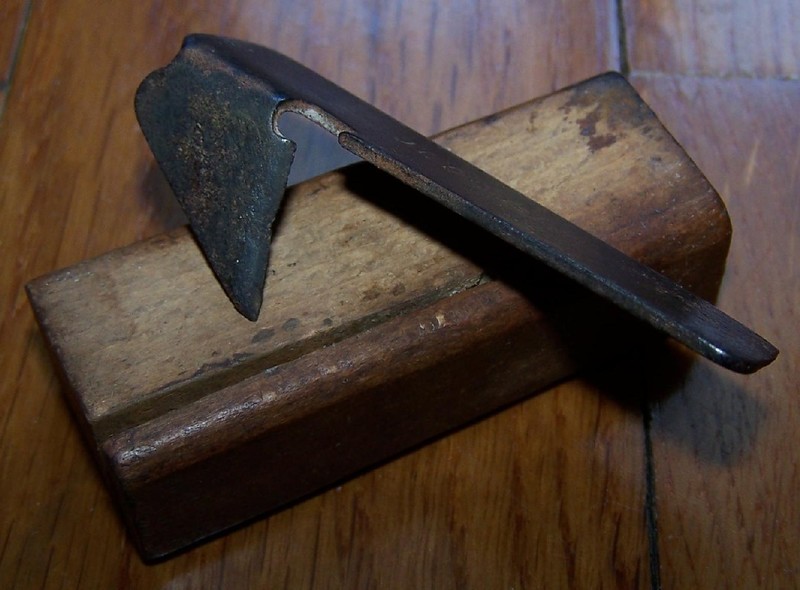 |
| Ouvre-boîte Darqué, modèle 1912 |
 |
| Dimensions, Ouvre-boîte Darqué, modèle 1912 |
But the story of Mr. Darqué's ouvre-boite does not end there. In 1913 he invented a folding version. Sacrebleu! The P-38 "John Wayne" that I had worn for so many years on my dog tag chain was not the product of American ingenuity! "How can that be?" thought I, but there it was, U.S. Patent number 1,082,800 of December 12, 1913, for E.M. Darque's "Tin Box Opener".

The folding version was apparently not adopted by the French Army, although it was manufactured in France post-WWI France for a salmon cannery in Newfoundland. In 1932, Darqué followed up with an improved version which included a blade locking device. In 1933 the patent was approved in the US as patent no. 1,921,911 and in the UK as patent GB386235(A).
 |
| Can Opener, Patent 1,921,911, August 8, 1933 |
 |
| Note the "key" (can opener) in the accessories section at the bottom of the illustration. |
C-Ration cans were still manufactured with a scored key-opening band below the top of the can. This caused problems when some of the contents of C-Ration meat unit would often spill out of the top of the can. Continued attempts at raising the band approximately 3/8 inch proved unsuccessful, as it weakened the container. "Nevertheless, the (Subsistence Research) Laboratory recommended that further efforts be made to develop a can with raised score that would withstand rough handling."; not exactly a rousing official endorsement of the P-38.
 |
| 1945 C-Ration Menu 1: note the key method of opening the can. |
Researching patents in the United States Patent and Trademark Office database for patents with "can opener" in the title from October 1940 through the end of WWII revealed that the first P-38-style can opener patent filed during this era was patent number 2,412,946, filed July 3, 1944 and approved on December 24, 1946. The patent related to improvements on existing designs, primarily in locking the blade against the body of the opener when not in use to eliminate the danger of injury to the user.
"But", one might argue, "why would the government allow one of its officers to patent such a device, rather than throwing it out into the public domain?" There is definitely a precedent for such a patent. On October 17, 1939, in order to prevent commercial exploitation without the permission of the inventor of that culinary delight known as the D-Ration (formerly known as the "Logan Bar"), the US Government took out a patent. for Major (later Colonel) Paul P. Logan of the Quartermaster Corps Technical Committee. Patent 2,176,086 "Concentrated Emergency Ration" was apparently filed without having to wait for approval.
Given the P-38's ancestry and preponderance of hard evidence in Mr. Darqué's favor, I for one am convinced that Etienne Darqué is the true father of the P-38. Major Dennehy may have been the stepfather who brought it to the Subsistence Research Laboratory, but credit must certainly be given to the individual GI who truly recognized the P-38 for the great piece of equipment that it is, and for popularizing it to the point of becoming a military and cultural icon.
* The original article proclaiming Major Dennehy as the inventor of the P-38 was originally published in 1985 by Maj. Renita Foster, and reprinted in 2009 (but no sources were cited in the article). The article may be found at http://www.army.mil/article/25736/the-best-army-invention-ever/
Sources:
QMC Historical Studies Number 6, The Development of Special Rations for the Army, September 1944
QM Corps CMH Pub 10-12-1, The Quartermaster Corps, Organization, Supply and Services, Erna Risch, US GPO, 1953.
Quartermaster Food & Container Institute for the Armed Forces, Operation Studies Number One, Volume XII, Ration Development, June 1947
http://patft.uspto.gov
http://ouvres-boites.com/index.php/2011/03/02/22-l-ouvre-boite-du-poilu-le-nouveau-couteau-a-conserves-darque
http://worldwide.espacenet.com
